Wudang Tai He Quan: The Celestial Dance of Supreme Harmony
In the misty embrace of China’s sacred Wudang Mountains, where Daoist monks have sought enlightenment for centuries, there exists a martial art so profound that practitioners describe it not merely as combat training, but as “meditation in motion.” This is Wudang Tai He Quan (武当太和拳)—the Supreme Harmony Fist—a sophisticated internal martial art that embodies the quintessence of Daoist wisdom through physical form.

The Sacred Origins
The origins of Tai He Quan are intertwined with the rich tapestry of Daoist cosmology and the legendary history of Wudang Mountain itself. As one of China’s most sacred Daoist sites, Wudang has been a crucible for internal martial arts since the Tang Dynasty (618-907 CE). However, Tai He Quan as we know it today represents the refined culmination of centuries of development through the Wudang Dragon Gate lineage.
According to traditional accounts, the form was systematized by Daoist adepts who spent decades in contemplative isolation among Wudang’s peaks. Through profound meditation and observation of natural patterns—the flow of water, the swaying of ancient pines, the flight paths of cranes—these masters distilled the fundamental principles of the universe into a sequence of movements that both express and cultivate internal harmony.
Tai He Quan synthesizes principles from three foundational Wudang systems:
- Tai Ji (太极) - The Supreme Ultimate, representing the cosmic balance
- Tai Yi (太一) - The Supreme Oneness, embodying primordial unity
- Ba Gua (八卦) - The Eight Trigrams, expressing the transformative patterns of existence
What distinguishes Tai He Quan from other martial arts is its explicit connection to Neidan (内丹), or Daoist Internal Alchemy—the esoteric practice of transmuting the practitioner’s vital essence into higher spiritual energy. Each movement serves as both physical technique and alchemical process, designed to refine the practitioner’s body, mind, and spirit simultaneously.
Philosophical Foundations: Beyond Dualism
The term “Tai He” (太和) itself carries profound significance in Daoist philosophy. It refers to the state of “Supreme Harmony” that precedes even the emergence of Yin and Yang—the undifferentiated unity from which all existence springs forth. When a Daoist master speaks of “Tai He,” they invoke not merely balance between opposites, but the transcendent reality that encompasses and surpasses all duality.
Master Liu Hongyi, a contemporary guardian of the tradition, explains: “In practicing Tai He Quan, we seek not to defeat an opponent but to overcome the illusion of separation itself. The ‘enemy’ is ultimately our own discord with the Dao.”
This philosophical depth transforms what might otherwise be merely physical movements into spiritual technology. The practitioner of Tai He Quan works to harmonize three essential relationships:
- Heaven and Earth (天地) - Connecting cosmic and terrestrial energies through the human vessel
- Body and Spirit (身神) - Unifying physical form with consciousness
- Self and Other (自他) - Transcending the perceived boundary between individual and environment
Through this threefold harmony, the practitioner gradually realizes what Daoists call “Tian Ren He Yi” (天人合一)—“Heaven and Human Become One”—the experience of unity with the cosmos that is the ultimate aim of Daoist practice.
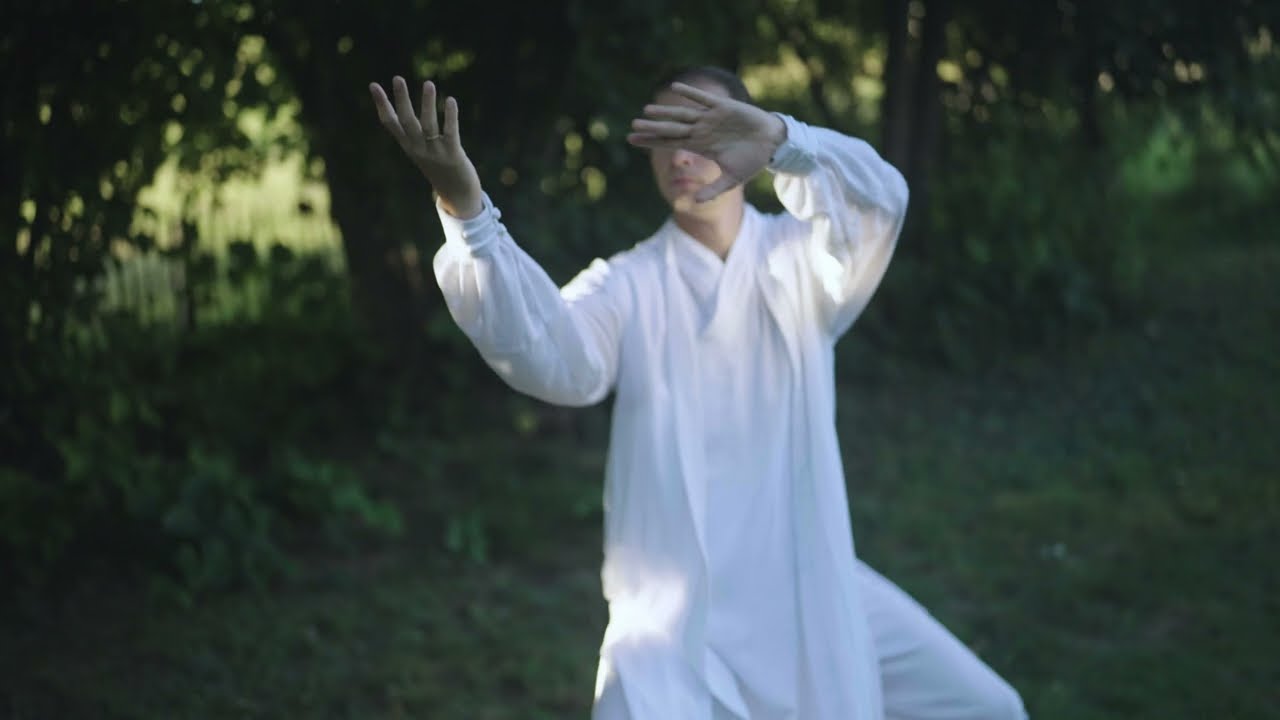
The Choreography of Consciousness: Understanding the 25 Movements
Tai He Quan consists of 25 movements, each with its own poetic name and profound symbolic significance. These movements flow together like a river returning to the sea—beginning in differentiation and culminating in unity. The entire sequence represents nothing less than the journey of creation and return to source that underlies Daoist cosmology.
The Journey Begins: From Stillness to Manifestation
-
无极势 (Wú Jí Shì) – Primordial Stillness
The form begins with the practitioner standing in apparent stillness, embodying the Daoist concept of Wuji—the formless void that precedes creation. Though outwardly motionless, internally the practitioner cultivates a state of alert receptivity, gathering energy in the lower dantian (energy center located below the navel).
Practice Note: Begin with feet shoulder-width apart, spine naturally extended, and breath calm and unhurried. Allow the mind to settle into tranquil awareness before initiating any movement.
-
气清上升为天,气浊下沉为地 (Qì Qīng Shàng Shēng Wéi Tiān, Qì Zhuó Xià Chén Wéi Dì) – Clear Qi rises to form Heaven, turbid Qi sinks to form Earth
This movement recreates the primal cosmic separation described in ancient Daoist texts. The hands begin to move, with the right palm rising gently upward (representing ascending, clear Yang energy forming Heaven) while the left palm descends (representing descending, dense Yin energy forming Earth).
Application: Beyond its cosmological significance, this movement trains the practitioner to distinguish between ascending and descending energetic currents in the body—a foundational skill for both health cultivation and martial application.
-
怀抱太极 (Huái Bào Tài Jí) – Embrace the Supreme Ultimate
The arms form a circle before the body, as if cradling a sphere. This represents Taiji, the dynamic interplay of Yin and Yang that emerges from Wuji. The practitioner cultivates awareness of the energetic sphere between the arms, feeling its subtle pulsation and density.
Historical Context: This posture appears in many ancient Daoist illustrations, symbolizing the adept’s ability to “hold” and nurture primordial energy. The sensation developed here—of tangible emptiness—becomes crucial in advanced Daoist practices.
The Middle Path: Transformation and Balance
The subsequent movements continue this cosmological journey, expressing progressively more complex interactions of elemental forces:
-
旋转乾坤 (Xuán Zhuǎn Qián Kūn) – Rotate Heaven and Earth
A spiraling motion that expresses the dynamic rotation of universal forces. The arms move in complementary spirals, training the body to generate power through coiling rather than linear force.
-
分两仪 (Fēn Liǎng Yí) – Separate into Yin and Yang
Here the practitioner physically embodies the philosophical concept of division into duality—the origin of all further differentiation in the universe. The movement creates a clear separation between left and right, establishing the foundation for the balanced oppositions that follow.
-
阴阳手 (Yīn Yáng Shǒu) – Yin-Yang Hands
The hands move with opposite qualities—one soft and receiving, one firm and directing. This trains the practitioner in the simultaneous expression of complementary energies, a skill essential for both martial application and energy cultivation.
-
天人合一 (Tiān Rén Hé Yī) – Heaven and Human Become One
This movement creates a vertical energetic alignment, connecting the three primary dantians (energy centers) with both Earth below and Heaven above. The practitioner experiences themselves as the conduit between cosmic forces.
-
雷火炼殿 (Léi Huǒ Liàn Diàn) – Thunder and Fire Temper the Palace
A more dynamic sequence that introduces vibrational energy (Thunder) and transformative heat (Fire) to refine the body’s energetic systems. The movements become slightly more vigorous, with subtle vibrations running through the limbs.
9-10. 左开玄门 (Zuǒ Kāi Xuán Mén) – Open the Mysterious Gate to the Left
右开玄门 (Yòu Kāi Xuán Mén) – Open the Mysterious Gate to the Right
These paired movements work with the “mysterious gates”—subtle energy points in the body that, when activated, allow for deeper spiritual perception and power. The movements are performed with particular attention to the opening and closing of the kua (hip/groin region) and the subtle rotation of the waist.
The Animal Essence: Nature’s Wisdom Embodied
The middle section of the form incorporates animal movements—not as mere imitation, but as embodiment of specific energetic qualities and states of consciousness:
- 一柱擎天 (Yī Zhù Qíng Tiān) – One Pillar Holds Up the Heavens
The practitioner stands tall and rooted, like a great cosmic pillar (often associated with the mythical Mount Kunlun in Daoist cosmology). This develops structural integrity and the ability to channel force directly through the body’s central axis.
- 狮子峰 (Shī Zi Fēng) – Lion Peak
Named after a famous peak on Wudang Mountain, this posture embodies the majestic, alert quality of the lion—representing both spiritual authority and martial readiness.
- 狮子滚绣球 (Shī Zi Gǔn Xiù Qiú) – Lion Rolls the Embroidered Ball
A more playful sequence that develops agile power and the ability to direct energy in circular patterns. The “embroidered ball” refers both to a traditional lion dance prop and, esoterically, to the cultivated energy pearl in Daoist alchemy.
- 黑虎巡山 (Hēi Hǔ Xún Shān) – Black Tiger Patrols the Mountain
Embodying the tiger’s vigilant, powerful presence, this movement develops awareness of one’s surroundings while maintaining internal centeredness. The “Black Tiger” in Daoist symbolism represents disciplined power and protective awareness.
- 银蛇盘柳 (Yín Shé Pán Liǔ) – Silver Snake Coils Around the Willow
Sinuous, fluid movements express the snake’s ability to coil and strike with perfect economy. This develops the practitioner’s capacity for storing and suddenly releasing energy, while the image of the willow represents flexible strength.
- 天鹅展翅 (Tiān É Zhǎn Chì) – Swan Spreads Its Wings
The graceful expansion of the swan’s wings represents spiritual openness and the body’s capacity for expansive awareness. This movement particularly works with the opening of the chest and heart center.
The Return to Unity: Spiritual Completion
The concluding movements of Tai He Quan represent the return to unity from multiplicity—the reversal of creation that is the heart of Daoist spiritual practice:
- 打金钟 (Dǎ Jīn Zhōng) – Strike the Golden Bell
A resonant movement that creates internal vibration, awakening deeper energy centers. The “Golden Bell” refers both to a protective Qi cultivation technique and to the sounding of spiritual awakening.
- 五龙捧圣 (Wǔ Lóng Pěng Shèng) – Five Dragons Support the Immortal
This elaborate sequence works with five types of energy (corresponding to the Five Elements) to elevate the practitioner’s spiritual essence. The “Five Dragons” can be understood as the five primary meridians being activated to support spiritual ascent.
- 海马吐雾 (Hǎi Mǎ Tǔ Wù) – Sea Horse Exhales Mist
A breathing-focused movement that trains the expulsion of turbid Qi through subtle spiraling motions. The “mist” represents both actual breath and, symbolically, the clouded mind becoming clear.
- 金龟摆头 (Jīn Guī Bǎi Tóu) – Golden Turtle Swings Its Head
Embodying the turtle’s longevity and wisdom, this movement develops neck flexibility while training the ability to observe without attachment. The turtle is one of Daoism’s four spiritual animals, representing primal wisdom.
- 天柱峰 (Tiān Zhù Fēng) – Heavenly Pillar Peak
Named after another Wudang Mountain peak, this posture reestablishes the cosmic alignment of the body as a conduit between Heaven and Earth, preparing for the final integration.
- 八卦转运殿 (Bā Guà Zhuǎn Yùn Diàn) – Bagua Circles the Luck Palace
A walking pattern that traces the eight trigrams of the Yijing (I Ching), connecting the practitioner with the fundamental patterns of change and transformation. This movement synthesizes all previous energies into a harmonious whole.
- 合太极 (Hé Tài Jí) – Gather the Supreme Ultimate
The reversal of the earlier Taiji embrace, this movement collects the cultivated energies back into the center, preparing for their integration into the practitioner’s core being.
- 收势 (Shōu Shì) – Closing Form
A formal closure that stabilizes the energy body after practice, ensuring that cultivated Qi is properly stored rather than dispersed.
- Implicit Integration Phase
Though not always explicitly named, the practice concludes with a period of standing meditation where all the energetic transformations are integrated. The practitioner returns to apparent stillness—but unlike the beginning, this stillness contains the fruit of the entire alchemical process.
Practice Methodology: The Inner Work
Tai He Quan is distinguished not just by its sequence of movements but by the quality of awareness that infuses them. Masters of the form emphasize several key principles:
Breath as the Bridge
The breath in Tai He Quan serves as the bridge between conscious intention and bodily movement. Unlike some practices that prescribe specific breathing patterns, Tai He Quan cultivates what is called “natural breathing” (自然呼吸), where the breath gradually deepens and refines itself through relaxed attention.
Advanced practitioners develop the ability to direct Qi through the “breath before breath”—the subtle energetic intention that precedes physical inhalation and exhalation.
Three Depths of Practice
Tradition identifies three progressive levels of practice:
- Form Level (形式层) - Learning the correct external movements
- Energy Level (能量层) - Cultivating and directing Qi through the movements
- Spirit Level (神意层) - Using the movements as gateways to spiritual realization
A famous Wudang saying reminds practitioners: “Ten years to understand the form, ten years to refine the energy, ten years to liberate the spirit.” This underscores the lifetime journey that Tai He Quan represents.
The Unified Body
Unlike external martial arts that may isolate specific muscle groups, Tai He Quan trains the body to function as an integrated whole. This integration develops through attention to several key principles:
- Three-Body Alignment (三体合一) - Coordinating head, hands, and feet
- Central Axis Rotation (中轴旋转) - Generating movement from the spine
- Six Harmonies (六合) - Linking shoulders to hips, elbows to knees, and wrists to ankles
Through these coordinations, the practitioner develops what is called “whole-body power” (整体力量)—the ability to express force from any point while maintaining complete structural integrity.
Beyond the Form: Applications and Benefits
While deeply rooted in spiritual practice, Tai He Quan is not divorced from practical application. Its benefits extend across multiple dimensions:
Martial Applications
As a combat art, Tai He Quan emphasizes:
- Yielding Neutralization - Using the opponent’s force against them
- Structural Disruption - Subtly affecting the opponent’s balance and coordination
- Energy Striking - Delivering impact with minimal external movement
Master Chen Wei, a contemporary teacher of the form, explains: “In Tai He Quan combat, we seek not to meet force with force, but to resolve conflict at its inception—before the opponent’s intention has fully manifested as action.”
Health Benefits
Regular practice of Tai He Quan has been associated with numerous health benefits:
- Improved posture and spinal alignment
- Enhanced respiratory efficiency
- Balanced autonomic nervous system function
- Increased joint mobility without strain
- Improved circulation and lymphatic flow
- Mental clarity and emotional resilience
Modern medical researchers have begun documenting these effects, with studies suggesting that the slow, mindful movements of internal arts like Tai He Quan may contribute to longevity and quality of life.
Spiritual Development
For practitioners focusing on its spiritual dimensions, Tai He Quan serves as:
- A moving meditation that calms the mind
- A method for cultivating and refining vital energy
- A practice of embodied philosophy—making abstract Daoist principles tangible
- A path to developing what Daoists call “spiritual embryo” (灵胎)—the seed of immortal consciousness
The Living Tradition: Contemporary PracticeThough ancient in origin, Tai He Quan remains a living tradition. After centuries of relative secrecy, when the form was transmitted only to selected disciples within Wudang monasteries, the latter half of the 20th century saw it gradually shared more widely.
Today, dedicated practitioners can study Tai He Quan both at its source on Wudang Mountain and through lineage-bearing teachers who have established schools internationally. The tradition strikes a careful balance between preservation and adaptation, maintaining its essential principles while making them accessible to contemporary students.
Authentic teachers emphasize that while the movements can be learned relatively quickly, the inner principles require patient cultivation. As the Daoist saying goes: “The form is the vessel, but understanding is the treasure.”
The Unending Path
Wudang Tai He Quan represents more than just another martial art form—it is a complete system for human development, a sacred technology for harmonizing body, energy, and consciousness. Through its practice, the ancient wisdom of Daoist sages becomes not just an intellectual concept but a lived reality.
For the dedicated practitioner, each performance of the form becomes both a return to origins and a new discovery—an endless spiraling path that, paradoxically, leads both deeper into oneself and beyond the boundaries of individual identity.
As expressed in the Daoist classic Dao De Jing: “Returning is the motion of the Dao.” In the flowing movements of Tai He Quan, this returning becomes not an abstract philosophy but an embodied reality—a dance of Supreme Harmony that bridges Heaven and Earth through the vessel of the human form.