Introduction to Wudang Taiyi Xuan Men Jian
The Wudang Taiyi Xuan Men Jian (武当太乙玄门剑), also known as the Wudang Daoist Sword, represents one of the most prestigious sword forms in Chinese martial arts. Originating from the sacred Wudang Mountains, this elegant sword form comprises 65 movements and embodies the essence of traditional Chinese weaponry. Within the vast array of sword forms practiced at Wudang Mountain, the Taiyi Xuan Men Jian stands as the most revered and sought-after. With a history spanning at least several hundred years, this ancient form teaches over 70 unique Wudang sword techniques characterized by movements that are both simple and unpretentious, alternating between fast and slow speeds.
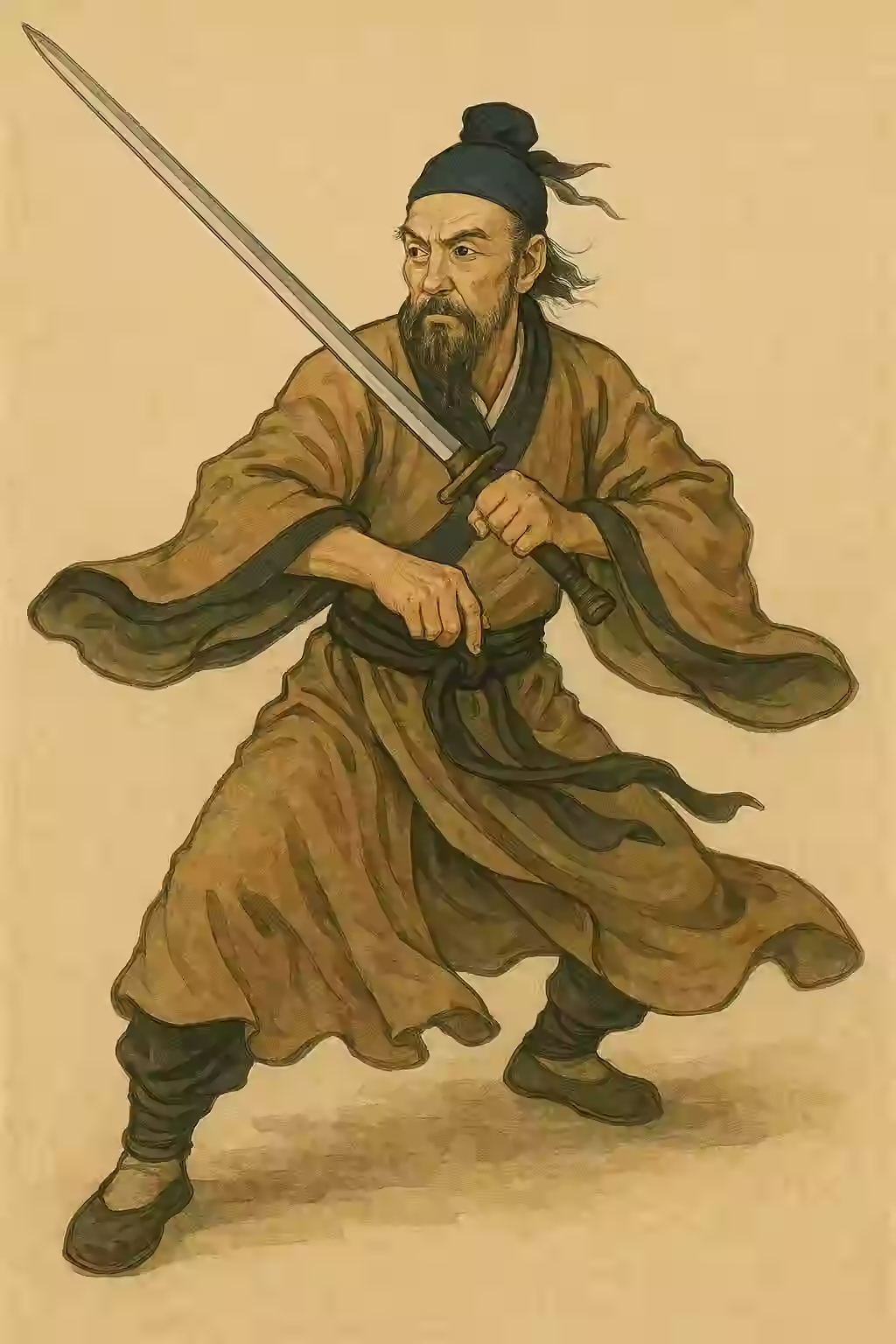
In Chinese martial arts tradition, the sword has been considered a manifestation of strength, power, privilege, and ability. The history of the sword in China traces back to the time of the Yellow Emperor, with technique and theory development beginning during the Warring States Period (475-221 BCE). The Wudang sword traditions specifically were preserved and refined within Daoist communities for centuries before becoming more widely taught.
The Sacred Nature of the Wudang Sword
In Daoist practice, the sword transcends its role as a mere weapon for combat. It represents justice and righteousness and symbolizes the discipline required to conquer ignorance, reckless passion, and aggression. During Daoist rituals, swords are often wielded as symbolic weapons to subdue evil forces, and traditionally, they were given to traveling Daoists to symbolize cutting away attachments to the material world.
The straight sword (jian) holds a special connection with Daoist religion, being considered the only weapon capable of banishing evil spirits. This is why it was always employed in exorcism ceremonies—a practice that continues to this day, sometimes with symbolic swords woven from Chinese coins substituting for real blades.
Philosophy and Practice Principles
What distinguishes the Wudang Taiyi Xuan Men Jian is its deep integration of martial skill with spiritual cultivation. When practicing this form, the mind leads the physical movement, and the body becomes one with the sword. This principle reflects the core philosophy of internal martial arts, where mental intention precedes and guides physical action.
Wudang Tai Chi Sword perfectly reflects Daoist culture and philosophy, including Qigong practices that transform the body’s energy substance into spiritual essence, ultimately returning to emptiness and reaching the Dao. It simultaneously strengthens the body, improves health, trains self-defense skills, and promotes longevity—combining characteristics of both a martial art and a health preservation exercise.
The sword itself embodies a flying dragon, with blades designed to be flexible and move with dragon-like qualities. With proper training, practitioners achieve a state where they become one with their sword—the highest level attainable in practice. This integration requires extensive fundamental training and the ability to generate power from the feet through the waist, shoulder, elbow, wrist, and finally to the sword tip.
The 65 Movements
The Wudang Taiyi Xuan Men Jian consists of 65 movements, each with a poetic name that evokes natural imagery and martial applications:
-
Qi Shi (起式) - Beginning Form
The opening stance that centers the practitioner’s energy and establishes balance before initiating the form. The feet are positioned shoulder-width apart, the body is centered, and the sword is held in a ready position. -
Qing Long Chu Dong (青龙出洞) - Green Dragon Comes Out of Its Cave
A forward thrusting movement where the sword emerges powerfully like a dragon leaving its cave. This technique combines advancing steps with an extending thrust that projects energy forward. -
Ba Yun Xian Ri (拔云见日) - Remove the Clouds to See the Sun
An upward clearing motion where the sword sweeps away imaginary clouds, symbolizing removing obstacles to achieve clarity. The practitioner creates an upward arc with the sword while stepping forward. -
Hen Fu Lai Chi (恨福来迟) - Regret the Fortune Comes Late
A contemplative sequence combining backward steps with circular sword movements, expressing the philosophical concept of timing and opportunity in life. The movement contains both regret and acceptance. -
Zi Yan Chuan Lin (紫燕穿林) - Purple Swallow Flies Through the Woods
A swift, elegant movement where the sword weaves through space like a swallow navigating between trees. This technique emphasizes agility, precision, and fluid motion. -
Chi Bei Dan Bian (反背单鞭) - Single Whip on the Back
A turning movement with extended arm position similar to the Tai Chi hand form’s Single Whip, but adapted for sword technique. The body turns while the sword extends outward in a whip-like action. -
Tian Bian Zhai Ri (天边摘日) - Pick Up the Sun on the Brink of the Sky
An upward reaching movement where the practitioner appears to pluck the sun from the horizon. This technique develops upward energy extension and connection with celestial energies. -
Xiu Li Cang Hua (袖里藏花) - Flowers Hide in the Sleeves
A concealing movement where the sword is momentarily hidden or controlled close to the body, representing strategic restraint and hidden power. This movement teaches economy of motion. -
Jin Bu Zhong Ci (进步中刺) - Thrust While Proceeding
A straightforward advancing step combined with a direct sword thrust to the center of the opponent. This movement teaches direct application of power while maintaining forward momentum. -
Hai Di Lao Yue (海底捞月) - Fish for the Moon in the Ocean
A downward scooping movement where the sword reaches low, as if trying to capture the moon’s reflection in water. This technique develops lower body stability while executing a graceful gathering motion. -
Ma Hou Yang Bian (马后扬鞭) - Wave the Whip Behind the Horse
A retreating step with a sweeping, defensive sword motion, often used to clear space after passing an opponent. This movement teaches defensive coverage while repositioning. -
Guai Mang Ru Tong (怪蟒入洞) - The Monstrous Python Hibernates in the Cave
A coiling movement where the sword and body move in snake-like fashion, representing the power and flexibility of a python. This teaches spiral energy and whole-body coordination. -
Ye Ma Fen Zong (野马分鬃) - Part the Mane of the Wild Horse
A separating movement where the sword parts imaginary obstacles, with dynamic footwork suggesting a wild horse’s energy. This technique develops power in separating motions. -
Hui Shen Qu Bao (回身取宝) - Turn Back the Body to Fetch the Treasure
A pivoting movement where the practitioner turns to retrieve something valuable behind them, demonstrating awareness in all directions. This develops spatial awareness and responsiveness. -
Jin Feng Xun Chao (金凤寻巢) - Golden Phoenix Searches for Its Nest
A series of circular searching movements with the sword tracing phoenix-like patterns in the air. This technique emphasizes elegant, circular motion combined with precision. -
Ling Mao Bu Shu (灵猫捕鼠) - Civet Cat Catches Mice
A quick, precise stabbing technique demonstrating the alert, predatory nature of a hunting cat. This movement teaches quick reactions and focused intent. -
Bai She Tu Xin (白蛇吐信) - White Snake Spits Out Its Tongue
A rapid, flicking movement of the sword tip mimicking the darting tongue of a snake. This technique develops control of the sword tip and small, precise movements. -
Fen Jian Fan Pi (分剑反劈) - Segment Swordplay and Chop
A sequence combining separating movements with a reverse chopping action. This technique teaches transitions between defensive separating and offensive cutting. -
Shang Bu Pi Jian (上步劈剑) - Step Forward and Chop with the Sword
An advancing movement combined with a powerful downward cutting motion. This technique emphasizes coordinating footwork with decisive cutting actions. -
Tou Feng Bao Jian (透风抱剑) - Play the Treasure Sword Fast as the Wing
A swift, circular technique where the sword moves so quickly it creates a breeze, displaying both speed and control. This develops the harmonious relationship between speed and precision. -
Tai Gong Diao Yu (太公钓鱼) - Tai Gong Hooks Fish
A hooking movement referencing the famous Chinese historical figure who fished with a straight hook, symbolizing patience and strategic control. This develops control and timing. -
Shun Feng Sao Ye (顺风扫叶) - Sweep the Leaves in the Direction of the Wind
A flowing sweeping motion that follows the natural direction of energy, effortlessly clearing the path. This technique teaches working with rather than against natural forces. -
Tou Feng Bao Jian (透风抱剑) - Play the Treasure Sword Fast as the Wing
A repetition of the earlier movement, emphasizing its importance in the form. The repeated practice develops consistent execution of this important technique. -
Zhi Zhang Quan He (执掌权和) - Hold Two Palms and Weight the Balance
A balancing posture where both hands work in coordination, suggesting the concept of harmony and equilibrium. This movement develops whole-body coordination. -
Shun Feng Lin Yi (顺风临衣) - Fetch the Coat with the Wind
A gathering movement where the sword and body move with the natural flow, like a coat blown by the wind. This technique teaches gathering energy with minimal resistance. -
Tian Gang Zhi Lu (天罡指路) - The Big Dipper Directs the Road
A pointing movement where the sword indicates direction like the Big Dipper constellation used for navigation. This technique connects physical movement with cosmological awareness. -
Shang Bu Dou Shen (上步抖身) - Step Forward and Shake the Body
An advancing step combined with a vibrating motion of the body and sword to generate and release energy. This technique develops whole-body connection and power generation. -
Shun Shui Tui Zhou (顺水推舟) - Slide the Boat Down the River
A flowing movement following the path of least resistance, like pushing a boat with the current. This technique teaches efficiency of movement and using natural momentum. -
Zhong Pan Yun Jian (中盘云剑) - Wave the Sword in the Middle Round
A circular technique performed at mid-level, creating cloud-like patterns with the sword. This movement develops fluid motion at the middle height range. -
Ce Mian Suo Hou (侧面锁喉) - Thrust the Throat Sideways
A lateral attacking movement targeting the throat area from an angle, demonstrating precision. This technique teaches angled attacks to vulnerable points. -
Ge Shang Jie Xia (隔上截下) - Separate the Above and Intercept the Below
A two-part defensive technique that simultaneously controls high and low attacking angles. This movement develops the ability to defend multiple lines simultaneously. -
Ye Cha Tan Hai (夜叉探海) - Night Spirit Explores the Sea
A probing movement with extended reach, like a mythological creature searching the depths. This technique develops extended awareness and reach. -
Hen Fu Lai Chi (恨福来迟) - Regret the Fortune Comes Late
A repetition of the earlier movement, reinforcing its philosophical significance. The repeated practice deepens understanding of both the technique and its meaning. -
Jin Lan Lian Huan (金兰连环) - Intercept the Flowing Rings
A linking technique where movements flow continuously like connected rings, emphasizing unbroken energy. This develops continuous, connected motion. -
Tui Chuang Wang Yue (推窗望月) - Open the Window and Enjoy the Moon
A spreading movement that creates space, as if opening a window to reveal the beauty beyond. This technique develops expansiveness and receptivity. -
Hui Shen Ci Xi (回身刺膝) - Turn Back the Body to Thrust the Knees
A pivoting movement combined with a low thrust targeting the opponent’s knee. This technique develops lower targeting and mobility. -
Yao Zi Fan Shen (鹞子翻身) - The Sparrow Turns Over the Body
A quick, agile turning movement mimicking a bird’s aerial maneuver. This teaches rapid direction changes and body control. -
Qing Ting Dian Shui (蜻蜓点水) - The Dragonfly Scratches the Surface of the Water
A light, precise touch with the sword tip, like a dragonfly briefly touching water. This technique develops lightness and precision in sword tip control. -
Huang Que Ji Gu (黄雀击鼓) - The Siskin Attacks the Crops
A percussion-like striking movement with the sword, swift and targeted. This movement develops rhythmic timing and percussive power. -
Fan Jiang Jiao Hai (翻江搅海) - Overturn Rivers and Seas
A powerful, sweeping movement that demonstrates the ability to affect vast areas, suggesting mastery over expansive spaces. This technique develops grand, expansive energy.
Training Methodology
Learning Wudang Tai Chi Jian requires extensive basic training. Practitioners must develop the ability to lunge with sound, allowing the strength to flow from the feet through the waist, shoulder, elbow, hand-wrist, and finally to the sword tip. Proper relaxation is essential—if the body is tense, power cannot transfer effectively to the sword. The power should originate from the Dantian (energy center).
The practice emphasizes the unity of mind and body with the sword. When properly executed, the practitioner doesn’t merely wield the sword—they become one with it, the weapon functioning as a natural extension of the body and mind. This represents the highest achievement in Wudang sword practice.