The Mystical Path of Wudang Baxian Gun
In the mist-shrouded peaks of Wudang Mountain, where heaven and earth seem to embrace, an extraordinary martial art was born. The Baxian Gun (八仙棍, Bā Xiān Gùn), or Eight Immortals Staff, isn’t just another weapon form—it’s a living legend winding through centuries of Daoist tradition, carrying within its 61 postures the very essence of mythical beings who transcended mortality.
This rare form remains one of Wudang Mountain’s most guarded treasures. Its movements flow like poetry, each posture telling the tale of one of the Eight Immortals—those colorful characters who populate Chinese folklore and represent the diverse paths to spiritual enlightenment.

The Legend of Li Tieguai
The story behind this form connects deeply to Li Tieguai (李铁拐, Lǐ Tiě Guǎi), the most mysterious of the Eight Immortals. According to ancient tales, Li was once a handsome practitioner who had mastered the skill of astral projection—sending his spirit to wander the celestial realms while his body remained behind. Before becoming an immortal, Li was reportedly quite handsome. During one of his spiritual journeys to the heavens, he instructed his disciple Li Qing to wait seven days for his return, and if he didn’t come back, to burn his body.
However, after waiting six and a half days, Li’s disciple received word that his mother was gravely ill. Believing his master wouldn’t return, he cremated Li’s body and rushed home. When Li’s spirit returned from his heavenly meeting, he found only ashes where his body should have been.
Facing disintegration, Li’s spirit had no choice but to enter the only available vessel—the corpse of a crippled beggar who had just died of starvation. This is why in all depictions, Li Tieguai appears as a disheveled, limping figure with an iron crutch.
Many Wudang martial arts practitioners believe the Eight Immortals Staff form was created after Li Tieguai’s transformation, channeling his experience of bodily transformation into a martial system that could transform practitioners both physically and spiritually.
https://neidan.app/en-eur/products/wudang-mountain-martial-arts-crossbody-bag
The Wudang Baxian Gun: A Living Art
The form contains 61 distinct movements, each named after characteristics or actions of the Eight Immortals. Far from being mere martial techniques, these postures embody the personalities, virtues, and magical abilities attributed to each immortal. Let’s explore each movement with its deeper meaning and application:
1. Centering Between Heaven and Earth - 起势 (Qǐ Shì)
Movement: Stand with feet shoulder-width apart, staff held vertically at the center line of the body, breathing deeply and relaxing the mind.
Deeper Meaning: This beginning posture represents the primordial state of wuji (无极, Wú Jí), the state of emptiness before creation. By centering oneself at the start of practice, the practitioner acknowledges that all movement emerges from stillness and all complexity from simplicity.
Martial Application: While appearing passive, this posture establishes the practitioner’s center of gravity and alert awareness, creating a foundation for explosive movement in any direction when needed.
2. Flowing with the Current - 顺水推舟 (Shùn Shuǐ Tuī Zhōu)
Movement: Step forward with the left foot while extending the staff in a smooth, effortless pushing motion, as if propelling a boat that’s already moving with the current.
Deeper Meaning: This movement embodies the Daoist principle of wu-wei (无为, Wú Wéi)—effortless action that aligns with the natural flow of events rather than forcing against them. The water metaphor suggests adapting to circumstances rather than struggling against them.
Martial Application: Rather than opposing an opponent’s force directly, this technique teaches redirection and the use of an attacker’s own momentum against them—a core concept in internal martial arts. The staff becomes an extension of this principle, requiring minimal force to create maximum effect.
3. Precise Intervention - 就地插针 (Jiù Dì Chā Zhēn)
Movement: From a stable stance, thrust the staff downward at a precise angle, as if inserting an acupuncture needle into a specific point on the ground.
Deeper Meaning: In Daoist medical practices, needles are used to restore balance by affecting specific meridian points. Similarly, this movement teaches that precise intervention at the right moment and location can have effects far beyond the apparent effort expended.
Martial Application: This teaches precision striking to vital points while maintaining a strong foundation. The downward angle creates a unique vector of attack that’s difficult to defend against, targeting weak points in an opponent’s stance or defense.
4. Spiritual Guidance - 仙人指路 (Xiān Rén Zhǐ Lù)
Movement: The practitioner points the staff forward in a clear, definitive gesture while stepping into a bow stance, eyes focused along the line of the weapon.
Deeper Meaning: The immortals in Daoist tradition are often depicted as guides who point the way toward spiritual development. This movement reminds practitioners that martial arts practice is also a path of spiritual awakening with clear direction and purpose.
Martial Application: Beyond its obvious use as a direct thrust, this movement trains proper alignment of body, weapon, and intention—the three must be unified for effective technique. The extended staff creates distance while threatening a precise attack.
5. Protection from Above - 黄云盖顶 (Huáng Yún Gài Dǐng)
Movement: Raise the staff horizontally above the head, creating a protective “roof” while maintaining a strong stance below.
Deeper Meaning: Yellow in Chinese cosmology represents the center and the earth element. This movement suggests divine protection from heaven—the yellow clouds (symbols of imperial or divine presence) provide shelter for those walking the spiritual path.
Martial Application: This movement trains defense against overhead attacks while maintaining stability and structure. The horizontal staff creates a barrier that can deflect downward strikes while positioning for an immediate counter-attack.
6. Strategic Patience - 太公钓鱼 (Tài Gōng Diào Yú)
Movement: Lower the body slightly while extending the staff with a subtle, enticing motion, like a fishing line being dangled in water.
Deeper Meaning: Named after the famous strategist and advisor Jiang Taigong, who was said to fish with straightened hooks, believing the fish would come to him willingly. This represents the Daoist virtue of patience and the art of strategic waiting.
Martial Application: This baiting technique draws opponents into attacking, creating an opportunity for counter-action. The seemingly vulnerable extended staff actually prepares for a rapid strike, sweep, or control technique once the opponent commits.
7. Unstoppable Progression - 铁牛耕地 (Tiě Niú Gēng Dì)
Movement: A powerful sweeping motion where the staff moves like a plow cutting through earth, performed with the whole body driving forward with inexorable momentum.
Deeper Meaning: The iron bull represents unflagging determination and consistent effort. In Daoist cultivation, steady practice over time yields profound transformation, just as a bull patiently plowing a field prepares the ground for future harvest.
Martial Application: This sweeping technique clears a wide area, effective against multiple opponents or weapons. The forward momentum makes it difficult to stop once initiated, creating a powerful offensive maneuver that combines defense and attack.
8. Liberation from Constraints - 汉钟离解衣 (Hàn Zhōng Lí Jiě Yī)
Movement: Open the stance while bringing the staff from close to the body outward in an expansive motion, as if removing constrictive clothing.
Deeper Meaning: Han Zhongli is often depicted with his robe open, exposing his rotund belly—symbolizing freedom from social constraints and conventional thinking. This movement represents the Daoist ideal of liberation from artificial limitations.
Martial Application: This technique creates space when surrounded or grappled, breaking free from an opponent’s control. The outward expansion of the staff can disrupt multiple attackers simultaneously while establishing a protected zone around the practitioner.
9. Renewal and Aspiration - 单凤朝阳 (Dān Fèng Cháo Yáng)
Movement: Rise from a lower position to a higher one, with the staff angled upward like a phoenix ascending toward the sun.
Deeper Meaning: The phoenix in Chinese mythology represents rebirth, transformation, and the fire element. This movement symbolizes aspiration toward enlightenment (the sun) and the constant renewal possible through spiritual practice.
Martial Application: This rising motion counters low attacks while preparing for an upward strike. The body’s elevation change creates momentum that can be channeled into the weapon, resulting in a powerful upward trajectory that can disrupt an opponent’s balance.
10. Celestial Speed - 追风赶月 (Zhuī Fēng Gǎn Yuè)
Movement: A dynamic advancing step with the staff extended forward in a swift, fluid motion that combines speed with graceful precision.
Deeper Meaning: Wind and moon represent speed and rhythm in Daoist symbolism. This movement teaches practitioners to align with natural cycles and forces—moving like the wind but with the measured pace of the moon’s orbit.
Martial Application: This powerful advancing attack uses speed and timing to overcome an opponent’s defenses. The forward momentum creates penetrating power, while the fluid motion allows for quick adaptation if the initial attack is countered.
11. Dynamic Combination - 玉兔弹腿 (Yù Tù Tán Tuǐ)
Movement: Combine a swift kick with a coordinated staff movement, mimicking the springing action of a rabbit.
Deeper Meaning: The jade rabbit, who in Chinese mythology lives on the moon and compounds the elixir of immortality, represents quick transformation. This movement integrates lower and upper body techniques, symbolizing the unity of heaven and earth forces.
Martial Application: This coordinated technique uses distraction and multiple angles of attack. While the opponent focuses on defending against the staff, the kick creates a second threat, making this an effective technique for creating openings in an opponent’s defense.
12. Concealed Readiness - 吕洞宾背剑 (Lǚ Dòng Bīn Bèi Jiàn)
Movement: Position the staff across the back momentarily, as if carrying a sword in a relaxed but ready position.
Deeper Meaning: Lü Dongbin carried his sword on his back while traveling, appearing as a scholar rather than a warrior. This symbolizes the Daoist preference for keeping one’s abilities restrained and concealed unless necessary—power hidden beneath a humble exterior.
Martial Application: This apparently vulnerable position is actually a preparation for a sudden, unexpected strike. By momentarily placing the weapon in a seemingly non-threatening position, the practitioner can lull an opponent into a false sense of security before launching a surprise attack.
13. Inverting Paradigms - 反振乾坤 (Fǎn Zhèn Qián Kūn)
Movement: A rotational movement where the staff describes a complete circle in the vertical plane, changing direction unexpectedly.
Deeper Meaning: “Qian” and “Kun” are the first two hexagrams in the I Ching (易经, Yì Jīng), representing heaven and earth. This movement symbolizes the Daoist understanding that apparent opposites can transform into each other—victory may emerge from seeming defeat, advantage from disadvantage.
Martial Application: This circular technique can reverse an opponent’s advantage by redirecting their force back against them. The complete rotation allows for recovery from a compromised position while simultaneously preparing a counter-attack from an unexpected angle.
14. Remaining Centered in Activity - 洞宾饮酒 (Dòng Bīn Yǐn Jiǔ)
Movement: A balanced posture where the staff is held at an angle while the body remains relaxed but alert, reminiscent of someone casually drinking wine.
Deeper Meaning: Lü Dongbin is often depicted enjoying wine, representing the Daoist belief that spiritual awareness can be maintained even during everyday activities. This posture teaches remaining present and conscious even in relaxed states.
Martial Application: This deceptively casual stance contains hidden readiness, allowing for immediate response to threats. The angled staff can quickly shift to defensive or offensive positions, while the relaxed body conserves energy and maintains flexibility for rapid movement.
15. Strategic Targeting - 拦腰取宝 (Lán Yāo Qǔ Bǎo)
Movement: Direct the staff in a horizontal movement toward an opponent’s midsection, as if intercepting and claiming a valuable object.
Deeper Meaning: In Daoist internal alchemy, the middle dantian (丹田, dān tián) located at the heart center contains vital spiritual energy. This movement symbolizes directing awareness to one’s energetic core to access inner treasures.
Martial Application: This strike targets the opponent’s center of gravity, where balance and breathing can be disrupted. The horizontal angle makes it difficult to evade without compromising stability, making it especially effective against an advancing opponent.
16. Balancing Opposition - 洞宾饮酒 (Dòng Bīn Yǐn Jiǔ) Left Side
Movement: Repeat the wine-drinking posture on the opposite side of the body, creating symmetry with the earlier movement.
Deeper Meaning: This deliberate mirroring teaches the Daoist principle of balance—what is done on one side must be harmonized on the other to maintain equilibrium of internal energies and physical structure.
Martial Application: Training techniques on both sides of the body ensures complete development and tactical flexibility. Being able to execute from either side prevents predictability and allows adaptation to any combat situation regardless of positioning.
17. Complementary Reversal - 反振乾坤 (Fǎn Zhèn Qián Kūn) Left Side
Movement: Perform the heaven-earth reversal movement on the opposite side, completing the balanced pair.
Deeper Meaning: By performing the same movement in mirror image, the practitioner embodies the Daoist understanding of complementary opposites—like the black and white areas of the taiji (太极, tài jí) symbol, each containing a seed of the other.
Martial Application: This ambidextrous training ensures that defensive and offensive capabilities are developed equally on both sides of the body. The complementary movements create a complete system of response that can address attacks from any angle.
18. Consistent Renewal - 单凤朝阳 (Dān Fèng Cháo Yáng) Repetition
Movement: Return to the phoenix-rising posture, now with deeper intent and more refined execution.
Deeper Meaning: The repetition of this movement emphasizes the importance of continual renewal and aspiration in spiritual practice. Just as the phoenix repeatedly rises from its own ashes, the practitioner continually elevates their consciousness through repeated practice.
Martial Application: This deliberate repetition reinforces the muscle memory and technical precision of a core movement. The rising energy of this posture creates an excellent transition between defensive and offensive sequences.
19. Integrated Dynamics - 玉兔弹腿 (Yù Tù Tán Tuǐ) Repetition
Movement: Return to the jade rabbit kicking posture with greater integration of upper and lower body movements.
Deeper Meaning: Repetition with refinement reflects the Daoist understanding of spiral development—returning to the same point but at a higher level of realization, like climbing a mountain path that circles the peak while constantly ascending.
Martial Application: This second execution allows for greater coordination between the staff techniques and footwork, creating a more seamless and powerful combined attack that can surprise opponents with its integrated dynamics.
20. Penetrating Awareness - 拨草寻蛇 (Bō Cǎo Xún Shé)Movement: Use the staff to make precise, searching movements low to the ground, as if carefully parting grass to reveal a hidden snake.
Deeper Meaning: This movement symbolizes the Daoist practice of penetrating observation that reveals hidden truths. The seeking quality teaches practitioners to look beneath surface appearances to find underlying realities.
Martial Application: This probing technique can locate and expose vulnerabilities in an opponent’s lower defenses. The low angle creates unusual vectors of attack that are difficult to defend against, preparing for strikes to the legs or feet.
21. Patient Strategy - 太公钓鱼 (Tài Gōng Diào Yú) Repetition
Movement: Return to the fishing posture with greater subtlety and strategic intent.
Deeper Meaning: The repeated fishing motion reinforces the Daoist virtue of patient waiting—understanding that timing is often more important than force. The wise practitioner, like Jiang Taigong, knows that the right opportunity will present itself naturally.
Martial Application: This baiting technique is refined through repetition, developing the practitioner’s ability to draw out an opponent’s attack at precisely the right moment for an effective counter. The seemingly passive stance conceals immediate readiness for action.
22. Developing Power - 铁牛耕地 (Tiě Niú Gēng Dì) Repetition
Movement: Execute the iron bull plowing movement again with greater force and rootedness.
Deeper Meaning: This repetition symbolizes the consistent effort required for spiritual transformation. Like the steady plowing of a field, spiritual cultivation requires persistent attention and energy applied consistently over time.
Martial Application: This powerful sweeping technique becomes more effective with repetition as the body learns to channel force from the ground through the legs, waist, and arms into the weapon. The repeated practice develops whole-body power that makes the technique nearly unstoppable.
23. Grounded Authority - 坐振山河 (Zuò Zhèn Shān Hé)
Movement: Lower into a stable seated stance while creating vibrating or shaking movements with the staff that propagate power from the lower body.
Deeper Meaning: Mountains and rivers in Daoist cosmology represent the enduring and the flowing aspects of nature. This movement teaches uniting stability with dynamic movement—being simultaneously grounded and expressive.
Martial Application: This technique generates power from the legs and waist that can be transmitted through the staff, creating “shock” waves that can disrupt an opponent’s structure. The seated position creates a lower center of gravity for stability while generating substantial force.
24. Elevating Consciousness - 单凤朝阳 (Dān Fèng Cháo Yáng) Third Repetition
Movement: Execute the phoenix-facing-sun movement a third time, with even greater elevation and refinement.
Deeper Meaning: The third repetition of this movement represents the completion of a cycle—the Daoist understanding of transformation often occurs in stages of three. This final iteration symbolizes full realization of one’s aspiration toward spiritual illumination.
Martial Application: With each repetition, this technique becomes more integrated and powerful. The third execution should demonstrate complete harmony between body position, weapon control, and intentional force, creating a perfectly balanced offensive-defensive position.
25. Harmonized Pursuit - 追风赶月 (Zhuī Fēng Gǎn Yuè) Repetition
Movement: Perform the wind-chasing-moon movement again with greater speed and fluidity.
Deeper Meaning: This repetition emphasizes the importance of aligning with natural rhythms and forces. By “chasing the wind and following the moon,” practitioners learn to harmonize their own movements with universal patterns.
Martial Application: The repeated practice of this rapid advancing technique develops confident footwork coordinated with weapon extension. The second execution should demonstrate improved balance between speed and control, allowing for a powerful attack that remains adaptable.
26. Earthward Force - 兔子蹬脚 (Tù Zi Dēng Jiǎo)
Movement: Execute a forceful downward pressing motion with the foot while coordinating staff movement, like a rabbit stamping the ground.
Deeper Meaning: This movement teaches the importance of connecting with the earth element for stability and strength. The rabbit in Chinese mythology is associated with the moon, creating a symbolic connection between celestial aspiration and earthly foundation.
Martial Application: This stamping technique develops rooted power that can disrupt an opponent’s balance. The coordinated staff movement creates a two-directional attack that divides the opponent’s attention, increasing the effectiveness of both components.
27. Elevated Agility - 跃步小跷 (Yuè Bù Xiǎo Qiāo)
Movement: Perform a light, hook-like kicking motion while executing a complementary movement with the staff, emphasizing agility and coordination.
Deeper Meaning: This movement represents transcending earthly limitations through spiritual practice. The light, elevated quality shows how disciplined training can lead to seemingly effortless skill—a common theme in Daoist development.
Martial Application: This technique combines deception with multiple angles of attack. The hook-kick creates an unexpected trajectory that can bypass defenses, while the coordinated staff movement prevents effective countering by controlling distance and threatening additional strikes.
28. Embracing Limitation - 拐李亮相 (Guǎi Lǐ Liàng Xiàng)
Movement: Position the staff like a crutch while adjusting posture to mimic Li Tieguai’s characteristic stance, suggesting adaptation to physical limitation.
Deeper Meaning: This movement honors Li Tieguai’s story of transformation, teaching that apparent disabilities can become unique sources of strength. The Daoist perspective sees limitations as opportunities for specialized development rather than obstacles.
Martial Application: This unconventional positioning creates unusual angles of attack that opponents find difficult to predict or counter. By mimicking a position of apparent weakness, the practitioner can disguise their true capabilities until the moment of strike.
29. Transcending Constraints - 铁拐李独步下云梯 (Tiě Guǎi Lǐ Dú Bù Xià Yún Tī)
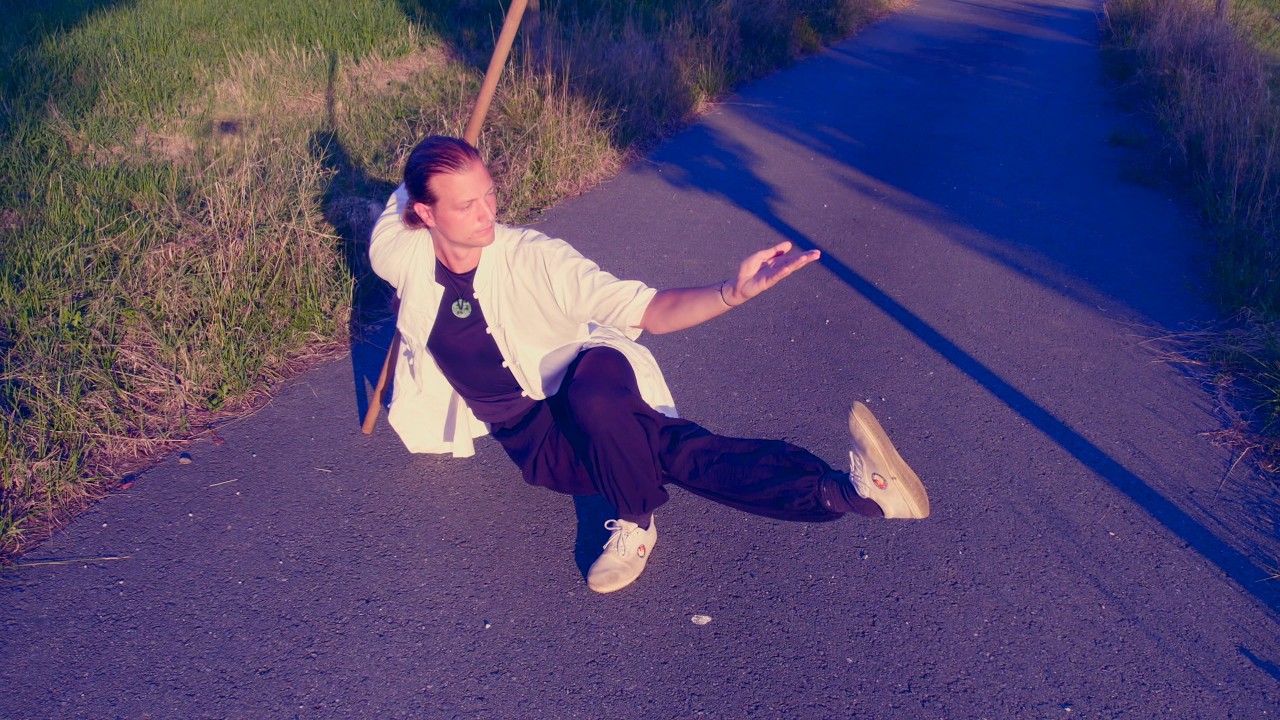
Movement: Balance on one leg while manipulating the staff vertically, as if descending a celestial ladder with limited mobility.
Deeper Meaning: Li Tieguai’s descent from heaven on one leg symbolizes the Daoist understanding that spiritual advancement doesn’t require physical perfection. This challenging movement teaches that mastery emerges through working with, rather than against, our limitations.
Martial Application: This one-legged technique develops exceptional balance and control while creating a deceptive appearance of vulnerability. The vertical staff creates a central axis of defense while enabling quick strikes in any direction, making this an unexpectedly versatile fighting position.
30. Expanded Awareness - 回头望月 (Huí Tóu Wàng Yuè)
Movement: Turn the head to look backward while maintaining forward stance with the staff, creating awareness in multiple directions simultaneously.
Deeper Meaning: This movement embodies the Daoist practice of expanded awareness—being conscious of what lies behind as well as ahead. The moon symbolizes reflection, suggesting that wisdom comes from being able to see one’s own past clearly.
Martial Application: This technique develops the critical combat skill of maintaining awareness of multiple threats simultaneously. The turned head allows for monitoring rear approaches while maintaining forward weapon control, preventing ambush while staying ready for frontal engagement.
31. Renewed Vigilance - 拨草寻蛇 (Bō Cǎo Xún Shé) Repetition
Movement: Return to the grass-parting, snake-seeking movement with greater precision and intent.
Deeper Meaning: This repetition emphasizes the Daoist understanding that vigilance must be maintained throughout spiritual practice. The continued searching quality represents the ongoing nature of self-examination and discovery.
Martial Application: The repeated practice of this probing technique refines the practitioner’s sensitivity to opportunities and threats. The second execution should demonstrate improved precision in identifying and targeting vulnerabilities in an opponent’s defenses.
32. Swift Precision - 白蛇吐信 (Bái Shé Tǔ Xìn)
Movement: Execute quick, darting movements with the staff tip, mimicking a snake’s tongue flicking in and out with precise control.
Deeper Meaning: The white snake in Chinese mythology is often associated with wisdom and transformation. This movement represents the Daoist quality of responsive adaptability—being able to test the environment and respond appropriately in the moment.
Martial Application: These quick, testing strikes develop the ability to probe an opponent’s defenses without committing fully to an attack. The unpredictable darting quality makes these movements difficult to counter, while their precision allows targeting of vulnerable points.
33. Harmonious Expression - 韩湘子吹笛 (Hán Xiāng Zǐ Chuī Dí)
Movement: Hold the staff in a position reminiscent of playing a flute, with smooth, flowing body movements coordinated with controlled breathing.
Deeper Meaning: Han Xiangzi’s flute playing represents harmony with cosmic forces through artistic expression. This movement teaches integration of breath, movement, and intention—key elements in Daoist internal cultivation.
Martial Application: This technique develops coordinated breathing with movement, essential for generating internal power. The flute-playing position creates a deceptively casual appearance while maintaining weapon readiness, allowing for sudden, unexpected strikes powered by breath control.
34. Alternating Rhythms - 白蛇吐信 (Bái Shé Tǔ Xìn) Repetition
Movement: Return to the white snake tongue-flicking movements, now with greater speed and unpredictability.
Deeper Meaning: The alternation between snake and flute movements demonstrates the Daoist principle of rhythmic change—understanding that effective action requires alternating between different qualities and approaches at the appropriate moments.
Martial Application: This repetition develops the ability to shift quickly between different fighting qualities. The contrast between the fluid flute posture and the sharp snake strikes trains adaptive responsiveness, allowing seamless transitions between different tactical approaches.
35. Flowing Continuity - 韩湘子吹笛 (Hán Xiāng Zǐ Chuī Dí) Repetition
Movement: Return to the flute-playing posture with greater fluidity and musical quality in the movement.
Deeper Meaning: This repetition emphasizes the importance of maintaining harmony even when returning to a previous state. The musical theme suggests that spiritual practice should maintain a flowing continuity rather than disjointed efforts.
Martial Application: The repeated practice of this flowing technique develops the ability to return to a centered, controlled state after more aggressive movements. This rhythmic alternation trains the critical combat skill of managing energy expenditure and recovery.
36. Perceptive Assessment - 蓝采和观望 (Lán Cǎi Hé Guān Wàng)
Movement: Assume a watchful stance with the staff positioned for observation rather than immediate action, emphasizing clear perception.
Deeper Meaning: Lan Caihe’s observational posture represents the Daoist priority of clear perception before action. This movement teaches the importance of seeing situations as they truly are before responding—a prerequisite for wise action.
Martial Application: This watchful technique develops strategic assessment skills during combat. The observational stance may appear passive but actually creates an ideal position for rapid response once an opponent’s intentions are revealed, embodying the principle of economy of movement.
37. Humble Receptivity - 童子拜月 (Tóng Zǐ Bài Yuè)
Movement: Lower the body in a bow-like motion while directing the staff toward the ground, creating a posture of reverence and receptivity.
Deeper Meaning: The image of children bowing to the moon represents the Daoist value of maintaining beginner’s mind (童心, tóng xīn)—approaching practice with humility and openness rather than presumed knowledge. The moon symbolizes illumination received through receptivity.
Martial Application: This lowered position creates a strong defensive structure while preparing for upward strikes. The bowing motion teaches how to absorb force through yielding before redirecting it, a core principle of internal martial arts.
38. Balancing Opposites - 左右阴阳 (Zuǒ Yòu Yīn Yáng)
Movement: Alternate the staff between left and right sides of the body with balanced, complementary movements that mirror each other.
Deeper Meaning: This movement directly embodies the fundamental Daoist principle of yin-yang harmony—understanding that opposites are not in conflict but in dynamic balance. The alternating sides represent how opposing forces can work together rather than against each other.
Martial Application: This balanced technique develops ambidextrous weapon control and whole-body coordination. The smooth transitions between sides train the ability to adapt quickly to changing circumstances, maintaining effectiveness regardless of positioning.
39. Expansive Control - 横扫千军 (Héng Sǎo Qiān Jūn)
Movement: Execute a wide, powerful sweeping motion with the staff that covers a large area around the body.
Deeper Meaning: The image of sweeping away thousands of soldiers represents the Daoist understanding that properly applied principles can have far-reaching effects. This movement teaches how focused intention can create expansive results through leverage and proper mechanics.
Martial Application: This sweeping technique is effective against multiple opponents, creating a zone of control around the practitioner. The horizontal plane of movement can simultaneously deflect numerous incoming attacks while threatening counters, making it valuable when outnumbered.
40. Complementary Forces - 左右阴阳 (Zuǒ Yòu Yīn Yáng) Repetition
Movement: Return to the alternating left-right movements with deeper understanding of their complementary nature.
Deeper Meaning: This repetition reinforces the Daoist principle that harmony requires ongoing attention to balance. The repeated yin-yang movements suggest that maintaining equilibrium is not a one-time achievement but a continuous process of adjustment.
Martial Application: The second execution of this balancing technique should demonstrate improved coordination between opposite sides of the body. This heightened integration creates more seamless transitions and greater power generation through the unity of complementary forces.
41. Graceful Strength - 美女献花 (Měi Nǚ Xiàn Huā)
Movement: Execute a graceful, offering gesture with the staff extended forward, combining aesthetic beauty with martial effectiveness.
Deeper Meaning: The image of a beauty presenting flowers represents the Daoist aesthetic principle that effectiveness need not sacrifice elegance. This movement teaches that spiritual accomplishment manifests as natural grace rather than forced effort.
Martial Application: This deceptively gentle technique disguises martial intent behind aesthetic movement. The offering position actually prepares for a precise thrust, demonstrating how beauty and function are not opposing qualities but can reinforce each other in combat.
42. Feminine Wisdom - 何仙姑献寿 (Hé Xiān Gū Xiàn Shòu)
Movement: Create circular, flowing movements with the staff while maintaining a dignified posture, honoring the feminine aspect of the Eight Immortals.
Deeper Meaning: He Xiangu, the only female immortal, represents the Daoist understanding of feminine wisdom and the yielding strength of yin energy. This movement teaches that receptivity and nurturing qualities are essential aspects of spiritual development.Martial Application: These circular techniques develop the ability to redirect rather than oppose force directly. The offering posture conceals powerful spiraling energy that can unbalance opponents through non-linear forces, demonstrating how apparent yielding can overcome rigid strength.
43. Unconventional Wisdom - 张果老倒骑毛驴 (Zhāng Guǒ Lǎo Dào Qí Máo Lǘ)
Movement: Assume an unconventional position with the staff, as if riding backward on a donkey like the eccentric immortal Zhang Guolao.
Deeper Meaning: Zhang Guolao’s backward riding symbolizes the Daoist value of unconventional wisdom and reversed perspective. This movement teaches that spiritual insight often requires looking at situations from unexpected angles, reversing habitual patterns of perception.
Martial Application: This unorthodox position creates unusual angles of attack that opponents find difficult to anticipate or counter. The reversed stance disrupts expected patterns of movement, creating strategic advantages through surprise and innovation.
44. Sustained Power - 铁牛耕地 (Tiě Niú Gēng Dì) Third Repetition
Movement: Execute the iron bull plowing movement a third time with maximum integration of body mechanics and intent.
Deeper Meaning: The third repetition of this movement represents the complete embodiment of steady, consistent power in spiritual practice. The iron bull symbolizes not just strength but unwavering commitment to the path of cultivation.
Martial Application: This final execution should demonstrate complete whole-body power, with force generated from the ground and channeled seamlessly through the staff. The repeated practice develops the ability to maintain powerful techniques even when fatigued, an essential combat skill.
45. Complete Renewal - 单凤朝阳 (Dān Fèng Cháo Yáng) Fourth Repetition
Movement: Perform the phoenix-facing-sun movement a fourth time, now with complete integration of physical technique and spiritual intent.
Deeper Meaning: The fourth repetition of this movement symbolizes complete mastery and transcendence. In Daoist numerology, four represents completeness and stability (as in the four directions). This final execution represents the full realization of the phoenix’s transformative potential.
Martial Application: With each repetition, this technique becomes more refined and powerful. The fourth execution should demonstrate complete unity of body, mind, and weapon, with no wasted energy and perfect timing. This level of mastery allows for instantaneous response based on deeply internalized understanding of the movement’s principles.
46. Releasing Conventional Knowledge - 曹国舅抛书 (Cáo Guó Jiù Pāo Shū)
Movement: Perform a casting-away motion with the staff, as if throwing books or scrolls aside with decisive intent.
Deeper Meaning: Cao Guojiu was of royal lineage but abandoned his privileged position to pursue spiritual cultivation. This movement symbolizes the Daoist understanding that conventional knowledge and social status must sometimes be set aside to achieve true wisdom and freedom.
Martial Application: This releasing technique develops the ability to decisively change tactics when necessary. The throwing motion generates surprising power through the rapid extension of energy, creating attacks that can bypass an opponent’s guard by changing the expected rhythm of combat.
47. Continuous Awareness - 回头望月 (Huí Tóu Wàng Yuè) Repetition
Movement: Perform the backward-looking movement again with deeper awareness and more subtle control.
Deeper Meaning: This repetition emphasizes the Daoist principle of continuous awareness in all directions. The moon, visible only when we look up from our immediate concerns, represents the broader perspective gained through expanded consciousness.
Martial Application: This technique refines multidirectional awareness, a critical survival skill in combat. The practitioner learns to maintain forward intention with the weapon while simultaneously monitoring spaces behind and to the sides, preventing surprise attacks while remaining offensively engaged.
48. Strategic Vulnerability - 醉卧仙床 (Zuì Wò Xiān Chuáng)
Movement: Lower the body into a reclining position while maintaining control of the staff, appearing relaxed or even intoxicated.
Deeper Meaning: The image of a drunken immortal lying on a celestial bed represents the Daoist concept of “appearing foolish while being wise” (大智若愚, dà zhì ruò yú). This movement teaches that sometimes the highest wisdom appears as simplicity or even apparent foolishness.
Martial Application: This deceptive technique uses apparent vulnerability to create strategic advantage. By appearing incapacitated or careless, the practitioner draws overconfident attacks that can be countered from unexpected angles, demonstrating how seeming weakness can disguise lethal capability.
49. Strategic Misdirection - 抛砖引玉 (Pāo Zhuān Yǐn Yù)
Movement: Perform a feinting motion with the staff followed by a more significant and precise strike from an unexpected angle.
Deeper Meaning: The Chinese idiom “throwing a brick to attract jade” refers to offering something of lesser value to attract something more precious. This movement embodies the Daoist strategy of using lesser actions to create opportunities for greater accomplishment.
Martial Application: This feinting technique develops the ability to create and exploit openings in an opponent’s defense. The initial movement draws attention and defensive response to one area, creating vulnerability elsewhere that can be exploited by the true attack—a fundamental principle in combat strategy.
50. Returning to Source - 坐振山河 (Zuò Zhèn Shān Hé) Repetition
Movement: Return to the seated mountain-shaking posture with greater rootedness and internal power.
Deeper Meaning: This repetition emphasizes the Daoist understanding that advanced practice often involves returning to fundamental positions with deeper realization. The mountain and river imagery represents the unification of stillness and movement—complementary forces brought into harmony.
Martial Application: This grounded technique develops the ability to generate power from the lower body even in a seated or low position. The repeated practice refines the connection between earth energy and explosive expression, creating surprising force that can be channeled through the staff in any direction.
51. Gentle Force - 汉钟离摇扇 (Hàn Zhōng Lí Yáo Shàn)
Movement: Create gentle waving motions with the staff like a fan being waved, generating subtle but penetrating force.
Deeper Meaning: Han Zhongli’s magic fan could revive the dead with its gentle movements, representing the Daoist principle that gentle, consistent force can create profound transformation. This movement teaches that subtle energy properly applied can be more effective than brute strength.
Martial Application: This fanning technique develops the ability to generate force through subtle rhythmic movements rather than obvious exertion. The waving motion can create disorienting effects that disrupt an opponent’s balance and timing while conserving the practitioner’s energy for decisive action.
52. Adaptive Precision - 白蛇吐信 (Bái Shé Tǔ Xìn) Third Repetition
Movement: Execute the snake tongue-flicking movements a third time with maximum speed and precision.
Deeper Meaning: The third repetition of this movement represents complete mastery of adaptive responsiveness. The white snake, associated with wisdom in Chinese mythology, symbolizes the intelligence that emerges from highly refined awareness and control.
Martial Application: The final execution of this technique should demonstrate perfect targeting precision at maximum speed. These qualities make the movement extremely difficult to defend against, as the attacks arrive at vulnerable points before the opponent can perceive and respond to the threat.
53. Controlled Mastery - 韩湘子勒马横笛 (Hán Xiāng Zǐ Lè Mǎ Héng Dí)
Movement: Combine a stopping or controlling motion with the flute-playing position, suggesting mastery over powerful forces while maintaining artistic expression.
Deeper Meaning: Han Xiangzi stopping his horse while playing his flute represents the Daoist ability to control powerful energies (the horse) while maintaining harmony with natural principles (the music). This movement teaches the balance between discipline and spontaneous expression.
Martial Application: This complex technique develops the ability to restrain and direct force simultaneously. The controlling aspect demonstrates mastery over momentum and timing, while the musical component maintains the flow and rhythm necessary for effective combat application.
54. Respectful Engagement - 吕洞宾提杯敬酒 (Lǚ Dòng Bīn Tí Bēi Jìng Jiǔ)
Movement: Extend the staff in a gesture of offering or toasting, combining social grace with martial readiness.
Deeper Meaning: Lü Dongbin proposing a toast represents the Daoist value of respectful engagement even with potential adversaries. This movement teaches that true mastery includes appropriate relationship with others, not just technical skill.
Martial Application: This offering technique disguises martial intent behind social convention. The toasting position actually creates an ideal preparation for a thrust or strike, demonstrating how proper etiquette and deadly skill are not mutually exclusive but can exist simultaneously in the accomplished martial artist.
55. Selective Gathering - 何仙姑采花 (Hé Xiān Gū Cǎi Huā)
Movement: Perform precise picking or plucking motions with the staff, as if carefully selecting flowers from a garden.
Deeper Meaning: He Xiangu’s flower gathering represents the Daoist practice of discriminating selection—choosing what to cultivate and what to leave aside. This movement teaches the importance of wise discernment in spiritual development.
Martial Application: This selective technique develops precision targeting of vital points. The careful picking motion trains the eye-hand coordination necessary for attacking specific vulnerabilities while avoiding an opponent’s strengths, demonstrating the principle that effectiveness comes from precision rather than power alone.
56. Apparent Yielding - 蓝采和献宝 (Lán Cǎi Hé Xiàn Bǎo)
Movement: Present the staff in an offering gesture that appears to yield control while actually preparing for a decisive action.
Deeper Meaning: Lan Caihe’s treasure-offering represents the Daoist paradox that apparent giving can lead to receiving, and seeming weakness can generate strength. This movement teaches that yielding is not the same as submitting—it can be a powerful strategic choice.
Martial Application: This yielding technique develops the ability to draw an opponent into a vulnerable position through apparent openness. The presenting motion invites an attack that can then be countered from an advantageous angle, demonstrating how strategic yielding can create superior fighting position.
57. Transforming Perspective - 曹国舅翻书 (Cáo Guó Jiù Fān Shū)
Movement: Create a turning motion with the staff as if flipping pages in a book, transforming the orientation and angle of the weapon.
Deeper Meaning: Cao Guojiu turning book pages represents the Daoist practice of examining ideas from multiple perspectives. This movement teaches that wisdom comes from considering many viewpoints rather than fixating on a single understanding.
Martial Application: This page-turning technique develops fluid transitions between different angles of attack and defense. The turning motion trains the wrist flexibility and forearm rotation necessary for controlling the weapon through complex patterns, allowing seamless adaptation to changing combat circumstances.
58. Ultimate Transcendence - 铁拐李独脚蹬天 (Tiě Guǎi Lǐ Dú Jiǎo Dēng Tiān)
Movement: Balance on one leg while extending the staff upward toward heaven in a powerful thrusting motion.
Deeper Meaning: Li Tieguai’s one-legged ascension represents the Daoist understanding that physical limitations can become spiritual advantages. This movement teaches that apparent obstacles can become unique pathways to transcendence when fully embraced.
Martial Application: This challenging technique develops extraordinary balance and focused power. The one-legged stance creates unusual movement patterns that opponents find difficult to predict, while the upward thrust generates surprising power from a seemingly unstable position, demonstrating how limitation can become specialized strength.
59. Decisive Action - 张果老举鞭 (Zhāng Guǒ Lǎo Jǔ Biān)
Movement: Raise the staff with decisive intent like a whip being prepared for a strike, combining controlled power with precise targeting.
Deeper Meaning: Zhang Guolao raising his whip represents the Daoist understanding that decisive action must follow clear perception. This movement teaches that while patience and observation are essential, they must culminate in appropriate response when the moment arrives.
Martial Application: This preparatory technique develops the ability to generate maximum power from a position of readiness. The raised position creates potential energy that can be released in any direction, allowing for multiple attacking options while maintaining control of distance and timing.
60. Return to Source - 落地生根 (Luò Dì Shēng Gēn)
Movement: Lower the staff to connect with the ground while establishing a firm, rooted stance, as if growing roots into the earth.
Deeper Meaning: The image of “falling to earth and growing roots” represents the Daoist principle of returning to one’s essential nature. This movement teaches that spiritual development is not about escaping earthly existence but deeply connecting with it.
Martial Application: This grounding technique develops the foundational stability necessary for effective combat. The rooting practice connects the practitioner’s energy with earth forces, creating a stable platform for both defense and offense while preventing being uprooted by an opponent’s techniques.
61. Integrating Experience - 收式 (Shōu Shì)
Movement: Return to a centered, balanced posture similar to the beginning position, but now infused with the energy and experience of the entire form.
Deeper Meaning: The closing posture represents the Daoist understanding of the cyclical nature of cultivation—ending where one began, but at a higher level of realization. This movement teaches that true mastery appears as simplicity, returning to fundamentals with profound understanding.
Martial Application: This concluding technique consolidates the energy developed throughout the form. The centered position reestablishes complete readiness while conserving the power generated in practice, demonstrating how apparent conclusion is actually preparation for further action—a principle applicable in both combat and spiritual cultivation.
The Hidden Teachings
What makes Baxian Gun truly special isn’t just its martial application but its ceremonial and spiritual dimensions. Each movement contains coded Daoist teachings:
When practicing “Luodi Shenggen” (落地生根, Luò Dì Shēng Gēn)—Root into the Ground—the practitioner doesn’t just establish physical stability but connects with earth energy, drawing strength like a tree deepening its roots. This posture teaches the fundamental Daoist principle of returning to source—finding power by connecting with our original nature rather than seeking it in external accomplishments.
In “Zhuifeng Ganyue” (追风赶月, Zhuī Fēng Gǎn Yuè)—Rush with the Wind and Keep Pace with the Moon—the rapid advance teaches more than just speed; it reminds us to align ourselves with natural cycles and cosmic rhythms. Daoists believe that human actions are most effective when synchronized with these greater patterns, just as a swimmer moves fastest when flowing with rather than against the current.Old masters tell that practicing the full sequence under moonlight, especially during the Mid-Autumn Festival (中秋节, Zhōng Qiū Jié) when the Eight Immortals are said to gather, can open doors to heightened awareness. The moonlight is believed to enhance the yin qualities of receptivity and internal awareness necessary for deeper spiritual insights, while the seasonal timing aligns human practice with cosmic cycles.
The form balances opposite energies throughout—expansion and contraction, hard and soft, advance and retreat—training the practitioner to harmonize opposing forces within themselves. This mirrors the Daoist understanding that immortality comes not from rejecting part of life but integrating all aspects of existence. The alternating movements serve as physical meditation on the principle that wholeness requires the balanced inclusion of complementary forces.
The Living Tradition
Today, this form remains one of the treasures of Wudang Mountain, passed down only to dedicated disciples who show both martial aptitude and spiritual maturity. The Wudang Eight Immortal School (武当八仙门, Wǔdāng Bā Xiān Mén) carefully guards this tradition, believing that its power lies not just in physical movements but in the transformation of consciousness they facilitate.
Traditional training follows a structured progression. Beginning students focus on correct physical execution of the movements, developing strength, flexibility, and coordination. Intermediate practitioners work on connecting breath with movement and understanding the martial applications. Advanced students explore the energetic and spiritual dimensions, using the form as a vehicle for internal alchemy (内丹术, nèi dān shù)—the Daoist practice of energy transformation for spiritual development.
Those who master this form don’t just learn a weapon—they embody the principles of the immortals themselves. Each swing of the staff becomes a bridge between worlds, each posture a reminder that within limitation lies transcendence, just as Li Tieguai found immortality through accepting his transformed body. The practice teaches that our greatest challenges often become our unique paths to realization when embraced completely.
When you see the staff spinning in the hands of a Wudang master, remember you’re witnessing not just martial artistry but a living thread connecting us to ancient sages who discovered that the path to heaven often winds through the most unexpected transformations of our earthly form. The flowing movements preserve centuries of wisdom about how physical discipline can serve spiritual awakening.
Just as Li Tieguai transformed tragedy into transcendence, the Eight Immortals Staff transforms mere fighting movements into a dance of mystical significance—a reminder that in Daoist tradition, mastery of the physical is merely the first step on a journey that ultimately transcends the body altogether. The true destination is not exceptional physical skill but the realization of one’s essential nature beyond all limitation.
https://neidan.app/en-eur/products/wudang-mountain-warrior-spiral-notebook