The Stone Monkey’s Legacy: How Myth and Prison Cells Shaped Monkey Kung Fu
The year was 208 AD, during the waning days of the Han Dynasty. A physician named Hua Tuo, already famous for inventing surgical anesthesia, watched animals move through the forests of ancient China. The tiger’s power, the deer’s grace, the bear’s strength, the bird’s balance—and the monkey’s unpredictable agility. From these observations, he created the Wu Qin Xi, the Five Animals Play, exercises that would echo through two millennia of Chinese martial arts history.
But the monkey would have to wait another fourteen centuries before truly coming into its own as a fighting style. Its transformation from medical exercise to combat art would require the convergence of literature, legend, and a most unusual prison sentence.
The Literary Catalyst
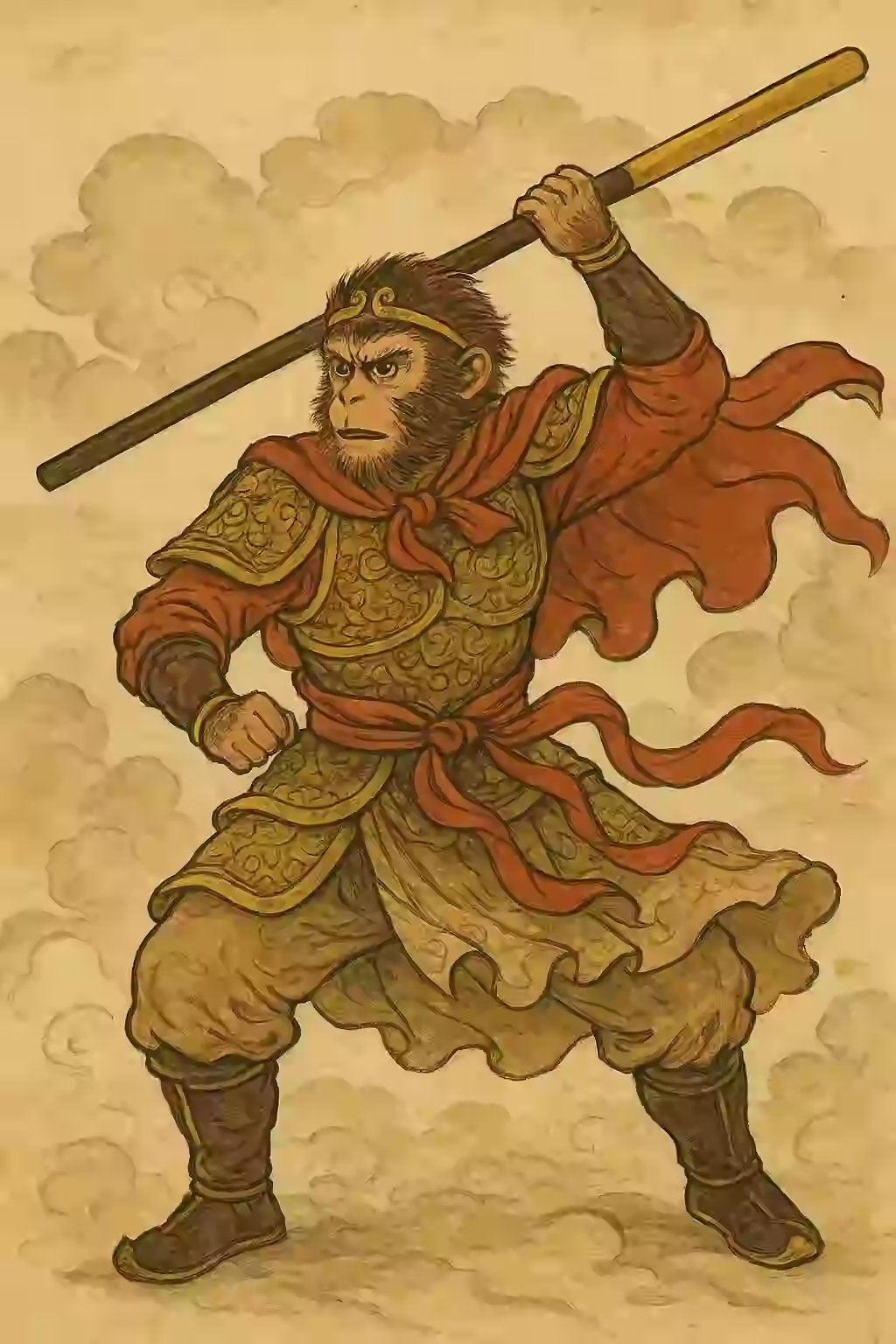
In the 16th century, during the Ming Dynasty, a novel appeared that would fundamentally reshape Chinese culture: Journey to the West, attributed to the scholar Wu Cheng’en. The epic tale introduced Sun Wukong, the Monkey King—a stone monkey born from a boulder on Flower Fruit Mountain, infused with the primal energies of heaven and earth.
Sun Wukong wasn’t just another folk hero. He was rebellion incarnate, a creature who literally erased his name from the Book of Death, declared himself “Qitian Dasheng” (Great Sage Equal to Heaven), and challenged the celestial bureaucracy itself. His arsenal included seventy-two transformations, the ability to somersault 108,000 li in a single bound, and the Ruyi Jingu Bang—a magical staff that could shrink to the size of a needle or expand to fill the universe.
The novel captured something essential in the Chinese imagination. Here was a character who fought not with rigid technique but with clever chaos, who defeated stronger opponents through trickery and unpredictability. For 500 years, Buddha trapped him under Five Finger Mountain as punishment for his rebellion against Heaven. Yet he emerged unbroken, eventually achieving Buddhahood himself after protecting the monk Tripitaka on his journey to retrieve Buddhist scriptures from India.
Which aspect of Sun Wukong’s legend resonates most with you?
- His rebellion against Heaven’s authority
- His journey from chaos to enlightenment
- His seventy-two transformations
- His unbreakable spirit during 500 years of imprisonment
- His clever trickery over brute force
The Prison Cell Revolution
The transformation of monkey mythology into martial reality occurred near the end of the Qing Dynasty, around 1911, in circumstances that seemed lifted from legend itself. A fighter named Kou Si from a small village in Northern China found himself imprisoned—some accounts say for accidentally killing an officer while resisting conscription, others claim he killed an evil man in a fight.
From his cell, Kou Si could observe a group of monkeys that frequented the prison grounds. Day after day, month after month, he studied their movements with the intensity of a man who had nothing but time. He watched how they dropped suddenly to avoid danger, how they attacked from impossible angles, how they used apparent weakness as a trap for the unwary.
Kou Si wasn’t starting from zero. He was already accomplished in Di Tang style, a ground-fighting system. But as he observed the monkeys, he began to see how their natural movements could revolutionize his existing knowledge. The way they scratched could become devastating claw attacks. Their nervous head movements could confuse opponents. Their sudden drops and explosive leaps could make a fighter unpredictable, almost impossible to counter.
Upon his release, Kou Si had developed something entirely new: Da Sheng Men—Great Sage Kung Fu—named explicitly after Sun Wukong. The style wasn’t just mimicry; it was a complete fighting philosophy that embraced chaos as strategy.
The Evolution Branches
Kou Si’s most significant student was Geng De Hai, who had been learning Pi Gua kung fu from his father Gan Wing Kwai since age eight. After his father’s death, Geng De Hai studied under Kou Si, eventually combining Da Sheng Men with his family’s Pi Gua style to create Da Sheng Pi Gua Men—a hybrid that became one of the most recognized monkey styles in martial arts.
But the development of Monkey Kung Fu wasn’t limited to Kou Si’s lineage. Multiple streams evolved independently across China:
Xing Zhe Men (行者門) took its name directly from Sun Wukong’s title in Journey to the West—"The Traveler." This variation emphasized the spiritual journey alongside the physical techniques.
Nan Hou Quan (南猴拳), or Southern Monkey Fist, developed from the Southern Shaolin Temple traditions. The cramped urban environments of southern China shaped this version into a close-range fighting system with quick, short movements and grappling techniques—dramatically different from its northern counterparts.
Meanwhile, in the mountains of Sichuan Province, the Emei region developed its own distinctive monkey style. The famous "Monkey King" Xiao Yingpeng became renowned for teaching a version that would later influence the modern wushu variant of monkey style seen in contemporary competitions. Mount Emei, one of China’s sacred Buddhist mountains and traditional "martial mountains," provided a unique environment where monkey techniques evolved alongside the region’s abundant wildlife.
The Five Monkey Personalities
As Monkey Kung Fu matured, practitioners identified five distinct fighting personalities within the style, each representing different tactical approaches:
Drunken Monkey emerged as perhaps the most deceptive variant. Practitioners would stumble, fall, and move with apparent intoxication while maintaining perfect control. The style incorporated false steps and off-balance strikes, sometimes lying prone on the ground to lure opponents into devastating knee or groin attacks.
Stone Monkey channeled Sun Wukong’s fierce warrior aspect—the version that challenged Heaven. This was the most aggressive variant, using powerful direct strikes and immovable stances that contrasted sharply with the style’s typically fluid nature.
Lost Monkey specialized in confused, panicked movements that hid precise counterattacks. Practitioners would appear frightened, their movements erratic and desperate, making it impossible for opponents to predict where the next strike would originate.
Standing Monkey broke convention by fighting from upright positions, confounding opponents who expected the characteristic low stances of monkey style. This deception proved especially effective against those who had studied conventional monkey techniques.
Wooden Monkey featured stiff, awkward movements that would suddenly explode into fluid combinations—the martial equivalent of playing dead before striking.
Which monkey personality fighting style intrigues you most?
- Drunken Monkey - deceptive intoxication
- Stone Monkey - aggressive direct power
- Lost Monkey - panicked confusion hiding precision
- Standing Monkey - upright deception
- Wooden Monkey - stiff to fluid explosions
The Northern and Southern Divide
Geography shaped Monkey Kung Fu into distinctly different northern and southern traditions. The open plains of northern China allowed for expansive movements—practitioners developed spectacular acrobatic techniques including flips, long-range attacks, and aerial maneuvers. Northern monkey stylists became known for their ability to cover ground quickly, using somersaults and diving attacks that seemed to defy physics.
The southern variations, particularly those from Guangdong and Fujian provinces, evolved in urban environments where space was limited. Southern Monkey Fist emphasized close-quarters combat, ground fighting, and rapid transitions between high and low positions. Where northern stylists might leap over an opponent, southern practitioners would drop and attack the legs.
The famous Five Animal styles of Southern Shaolin—Tiger, Crane, Leopard, Snake, and Dragon—sometimes incorporated monkey techniques, though monkey wasn’t always included in the canonical five. Different schools made different choices, with some traditions replacing dragon or leopard with monkey, reflecting regional preferences and teaching lineages.
From Temple to Street
The early 20th century brought dramatic changes to Monkey Kung Fu. The fall of the Qing Dynasty in 1911, the same year traditionally given for Kou Si’s development of Da Sheng Men, marked a period of social upheaval that dispersed martial artists across China and eventually the world.
During the Republic period (1912-1949), the Kuomintang government’s Central Guoshu Institute attempted to catalog and systematize Chinese martial arts. Monkey style practitioners found themselves demonstrating alongside masters of other systems, leading to cross-pollination of techniques. Some Northern Praying Mantis schools incorporated monkey footwork. Wuzuquan practitioners adopted monkey hand techniques.
The Communist era initially suppressed traditional martial arts as feudal superstition, but by the 1950s, the government had reorganized them under the banner of "wushu"—martial arts as sport and cultural heritage rather than combat training. The modern wushu version of monkey style, heavily influenced by the Emei tradition and Xiao Yingpeng’s teachings, emphasized spectacular acrobatics and performance elements.
The Mythical Meets the Martial
Throughout its evolution, Monkey Kung Fu maintained a unique relationship with its mythological roots. Practitioners didn’t just learn techniques; they studied Sun Wukong’s character. Training sessions might begin with meditation on the Monkey King’s journey from stone egg to Buddha. Advanced students learned that the seventy-two transformations weren’t just fantasy—they represented the principle of infinite adaptability in combat.
The style’s emphasis on facial expressions—practitioners trained to show happiness, anger, fear, confusion, and bewilderment—came directly from theatrical traditions depicting Sun Wukong. These expressions weren’t mere performance; they served tactical purposes, unsettling opponents and masking true intentions.
The monkey staff, or hou gun, became the style’s signature weapon, directly connected to Sun Wukong’s Ruyi Jingu Bang. Practitioners learned to use the staff not just as a weapon but as an extension of monkey movement—using it to vault, sweep, and create unexpected angles of attack.
Modern Transmissions
The late 20th century saw Monkey Kung Fu explode into global consciousness through Hong Kong cinema. The 1970s and 1980s produced a wave of monkey-style films, though many, like "Mad Monkey Kung Fu" (1979), actually showcased the monkey variation of Hung Gar rather than authentic Da Sheng Pi Gua. Jackie Chan’s "Drunken Master" films popularized the Drunken Monkey variant, though mixed with other drunken boxing styles.
Each transmission changed the art. In Japan, where Journey to the West had been known since the 17th century (with copies discovered in the Kozanji Temple catalog), monkey techniques influenced the development of certain Shorinji Kempo movements. The complete Ming edition of the novel arrived in Japan in the late 18th century, with the first complete Japanese translation published in 1835, illustrated by Taito II, a student of the famous artist Hokusai.
The style even influenced modern video games and animation. Characters from "Street Fighter" to "Virtua Fighter" incorporated monkey-style movements. The character Sun Wukong himself appeared in hundreds of games, each interpretation spreading awareness of monkey combat philosophy to new generations.
The Living Tradition
Today, Monkey Kung Fu exists in multiple forms. Traditional schools preserve the combat applications—the eye gouges, throat strikes, and groin attacks that Kou Si developed in prison. These schools maintain the style’s foundation in ground fighting, teaching students to attack from positions most martial artists consider compromised.
Competition wushu presents a different face: spectacular, acrobatic, and athletic. Modern competitors perform sequences that would seem impossible to Kou Si—multiple aerial flips, one-handed handsprings, and spinning movements that blur the line between martial arts and gymnastics.
Between these extremes, countless variations flourish. Some emphasize the spiritual journey of Sun Wukong. Others focus on practical self-defense. Urban parkour practitioners have discovered unexpected parallels with traditional monkey movement. Mixed martial artists study monkey-style ground transitions.
What draws you most to martial arts traditions?
- Historical and cultural connections
- Practical self-defense applications
- Physical fitness and acrobatics
- Philosophical and spiritual aspects
- Connection to mythology and stories
- Community and lineage traditions
The Immortal Style
The legend says Sun Wukong achieved immortality through seven different methods—eating the Peaches of Immortality, drinking the Elixir of Life, learning the secret from his master Subhuti, erasing his name from Death’s ledger, and more. This excessive immortality speaks to something profound: the refusal to accept any limitation.
Monkey Kung Fu embodies this same principle. From Hua Tuo’s medical exercises to Kou Si’s prison revelations, from theatrical performances to modern MMA cages, the style continues to transform, adapt, and survive. It refuses the limitation of rigid technique, the constraint of predictable movement, the boundary between high art and street fighting.
Mount Emei still hosts martial arts competitions where practitioners demonstrate monkey techniques against the backdrop of mist-shrouded peaks. The Shaolin Temple includes monkey forms in its curriculum. Small schools in village backstreets preserve variations unknown to the wider world. Each tradition claims authenticity, yet the style’s true authenticity might lie in its endless mutation.
The Stone Still Hatches
In Beijing’s Temple of Heaven Park, in village squares across Sichuan, on the competition floors of international wushu tournaments, the monkey still moves. Practitioners drop to all fours, scratch behind their ears mid-kick, screech to unnerve opponents, and spring from impossible positions to attack.
They embody a creature born from stone who challenged Heaven itself, who survived 500 years of imprisonment, who transformed from cosmic troublemaker to enlightened Buddha. They practice a style born in a prison cell, shaped by literature, and scattered across the world by revolution and cinema.
The movements Hua Tuo observed in 208 AD, the character Wu Cheng’en immortalized in the 16th century, the techniques Kou Si developed in 1911—all converge in every monkey stylist who drops into that distinctive crouch, grins with mischievous intent, and prepares to prove that chaos, properly channeled, defeats rigid strength every time.
Sun Wukong’s stone egg took countless ages to hatch on Flower Fruit Mountain. Monkey Kung Fu, too, required centuries of gestation—medical exercises evolving through mythology into combat reality. And like the Monkey King himself, the style achieves its own immortality not through rigid preservation but through endless transformation, each generation adding their own chapter to an ever-growing legend.
The prison cell where Kou Si watched monkeys has long since crumbled. But somewhere, right now, a student is learning to drop unexpectedly, to attack from impossible angles, to transform weakness into strength. The stone monkey, it seems, is still hatching.
https://neidan.app/en-eur/products/monkey-king-warrior-wood-framed2